
Our Blog.
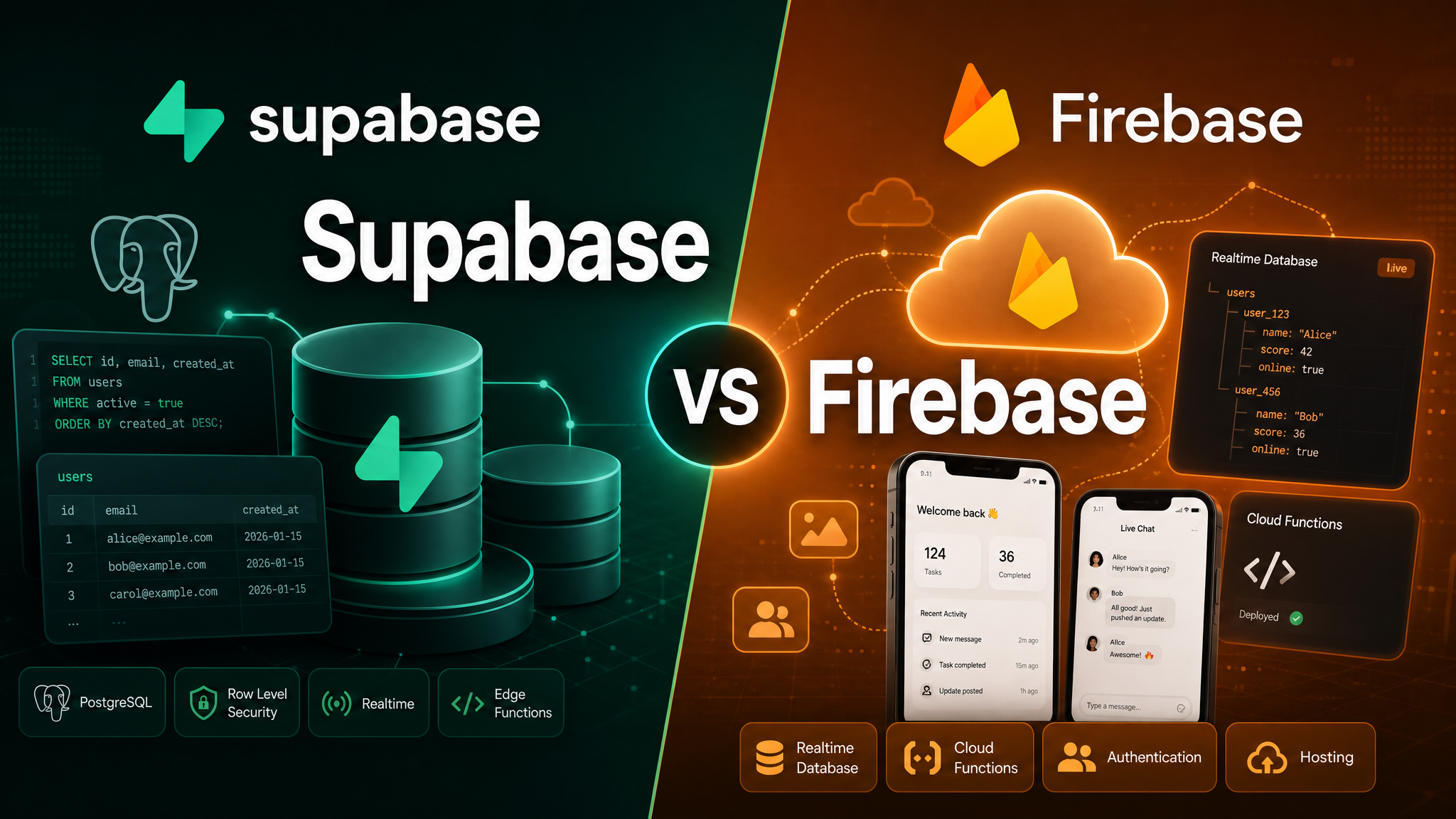
Supabase vs Firebase (2026): Which Backend Platform Is Better for Modern Apps?
If you’re comparing Supabase vs Firebase in 2026, you’re probably not just choosing a database. You’re choosing a backend stack, data model, scaling path, and developer workflow that will shape how fast your product ships for the next year or two.
Supabase is usually the better fit for teams that want Postgres, SQL, better local development, and more control over their backend architecture. Firebase is usually the better fit for teams that want Google’s managed ecosystem, strong mobile tooling, and a flexible pay-as-you-go model for event-heavy apps.
Here is the practical buyer’s comparison.
Quick Comparison Summary
| Feature | Supabase | Firebase |
|---|---|---|
| Best For | Teams that want Postgres, SQL, and a more transparent backend model | Teams that want Google’s managed app stack and mobile-friendly services |
| Core Strength | Relational data, local dev, open-source flexibility, and predictable packaged plans | Deep Google ecosystem integration, strong mobile tooling, and usage-based scaling |
| Pricing Shape | Plan-based with included usage plus project-level compute and overages | Spark free tier plus Blaze pay-as-you-go usage across products |
| Data Model | Postgres with SQL, joins, and relational workflows | Firestore / Realtime Database with document-oriented patterns |
| Best Buying Trigger | You want a backend that feels closer to conventional app architecture | You want managed velocity for mobile apps and Google-native services |
Pricing Comparison
Pricing is one of the biggest differences between these two platforms because the billing models feel very different.
| Tool | Current Pricing Snapshot |
|---|---|
| Supabase | Supabase Supabase has a Free plan, a Pro plan starting at $25/month, a Team plan starting at $599/month, and custom Enterprise pricing. Pro includes 100,000 MAUs, 8 GB disk, 250 GB egress, 100 GB storage, and $10/month in compute credits. Extra compute is priced per project, with instances ranging from $10/month for Micro to larger dedicated tiers. |
| Firebase | Firebase Firebase offers a Spark free tier and a Blaze pay-as-you-go model. The appeal is that many teams can start free, then pay only for actual usage across services like Firestore, Cloud Functions, Cloud Storage, and App Hosting. That flexibility is powerful, but it also means costs can become harder to predict once usage spreads across multiple Firebase and Google Cloud services. |
If your team wants a clearer packaged starting point, Supabase is easier to reason about. If your team prefers usage-based elasticity and already likes the Google Cloud stack, Firebase can be more attractive.
Supabase Overview
Supabase is best understood as a developer-friendly Postgres platform rather than just a Firebase alternative. It gives you a managed relational database, authentication, storage, realtime, edge functions, and a growing set of platform features, but the big draw is still Postgres. For a lot of teams, that means fewer compromises when schemas get more complex and reporting needs become more serious.
Its biggest advantage is architectural clarity.
Firebase Overview
Firebase remains one of the fastest ways to ship app backends, especially for mobile teams that want authentication, analytics, messaging, hosting, functions, and database services in one managed ecosystem. It is broad, mature, and deeply tied to Google infrastructure. The tradeoff is that teams often need to think in Firebase patterns first, especially around data modeling and pricing behavior.
Its biggest advantage is ecosystem convenience.
Head-to-Head: Key Differences
Database Model
Supabase wins if your product benefits from relational queries, joins, SQL, and the wider Postgres ecosystem. Firebase wins if your team is happy with document-oriented modeling and wants to optimize for app sync and managed simplicity.
Developer Experience
Supabase is usually easier for backend and full-stack developers who want local tooling, SQL migrations, and a system that feels close to traditional web app architecture. Firebase is often easier for teams already comfortable with Google’s tooling and event-driven service mix.
Pricing Predictability
Supabase is usually more predictable at the plan level because the starting package is clearer. Firebase can be cheaper for some lightweight or bursty workloads, but it can also get fuzzier as usage spreads across Firestore, functions, storage, bandwidth, and other Google Cloud-linked services.
Mobile App Fit
Firebase still has a very strong story for mobile teams because of its long-standing Android and iOS ecosystem support, analytics, messaging, and app operations tooling. Supabase can absolutely support mobile apps, but Firebase often feels more native in that world.
Control and Portability
Supabase gets the edge if your team cares about open-source alignment, SQL portability, and a backend that feels less locked into a proprietary data model. Firebase gets the edge if your team values managed speed more than architectural portability.
Best Buyer Profile
If the buyer is a startup CTO, indie SaaS founder, or engineering lead who wants a backend that can grow into a more conventional product architecture, Supabase is usually the better fit. If the buyer runs a mobile-first product team and wants tight integration with Google’s broader services, Firebase deserves the nod.
Who Should Choose Supabase?
Choose Supabase if: you want Postgres, SQL, clearer plan economics, strong local development, and a backend that feels closer to mainstream app engineering practices.
Who Should Choose Firebase?
Choose Firebase if: you want Google’s app stack, strong mobile support, a wide managed service portfolio, and a pay-as-you-go model that can flex with uneven usage.
The Verdict
For most modern SaaS teams comparing the two in 2026, Supabase is the better default choice when developer control, relational data, and long-term architecture flexibility matter most. Firebase is the better choice when mobile-first execution, managed convenience, and Google ecosystem leverage matter more than SQL-first design. Supabase wins on backend clarity. Firebase wins on managed ecosystem breadth.
Ready to Choose?
View Supabase pricing → | View Firebase pricing →
DrComps may earn a commission through affiliate links at no extra cost to you.
View Supabase pricing → | View Firebase pricing →
DrComps may earn a commission through affiliate links at no extra cost to you.
Comments (0)