
Our Blog.
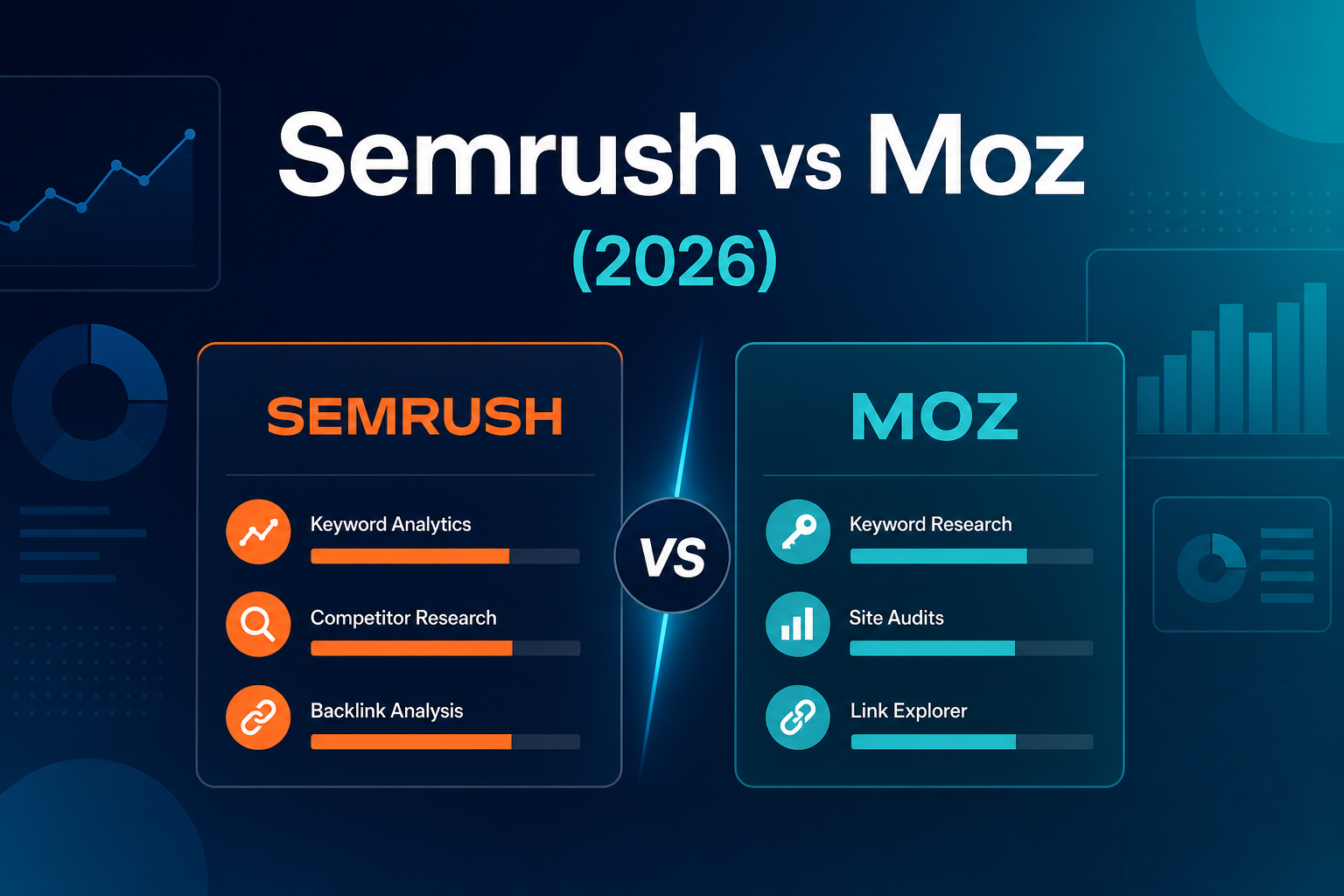
Semrush vs Moz (2026): Which SEO Suite Is Better for Growing Marketing Teams?
If you’re comparing Semrush vs Moz in 2026, you’re usually not looking for an abstract debate about which SEO brand has the better reputation. You’re trying to decide which platform will help your team research keywords, track rankings, find optimization opportunities, and actually move organic traffic without wasting budget on tools your team will barely use.
Semrush is usually the better fit for teams that want a broader SEO and digital marketing suite with deeper competitive research, larger workflow coverage, and stronger all-in-one breadth. Moz is usually the better fit for teams that want a more approachable SEO platform with solid core functionality, cleaner onboarding, and less operational sprawl.
Here is the practical buyer’s comparison.
Quick Comparison Summary
| Feature | Semrush | Moz |
|---|---|---|
| Best For | Teams that want broad SEO research, competitor intelligence, and adjacent marketing tooling in one platform | Teams that want focused SEO workflows with an easier learning curve |
| Core Strength | Breadth across keyword research, site audits, competitive analysis, content workflows, and PPC-adjacent data | Approachability, trusted core SEO metrics, and a simpler operating experience |
| Ease of Use | Powerful but can feel dense | Usually easier for smaller teams to learn quickly |
| Competitive Research Depth | Usually stronger | Useful, but not as expansive |
| Best Buying Trigger | You want one platform to handle more of the SEO operating stack | You want dependable SEO tooling without paying for a more sprawling suite |
Pricing Comparison
Pricing shifts over time, but the practical cost story in 2026 still looks familiar.
| Tool | Current Pricing Snapshot |
|---|---|
| Semrush | Semrush Semrush usually carries the higher price ceiling because it packages a broader set of research, reporting, content, and competitive features. For teams that will actually use that breadth, the higher spend can still make sense. |
| Moz | Moz Moz generally stays easier to justify for teams that want dependable rank tracking, keyword research, site audits, and link insights without stepping into a larger all-in-one marketing stack. |
If your team needs maximum workflow coverage, Semrush often justifies the premium. If you mostly need core SEO execution without tool sprawl, Moz can be the cleaner buy.
Semrush Overview
Semrush remains one of the strongest broad SEO platforms in 2026 because it does more than one job well enough to replace multiple point solutions for many teams. Keyword research, competitor visibility, site audits, backlink analysis, SERP monitoring, and content workflow support all live inside the same operating environment.
That matters because many SEO teams do not just need rankings data. They need to understand who is winning the SERP, where competitors are gaining momentum, which pages are decaying, and where new content opportunities are emerging. Semrush usually gives more surface area for that kind of multi-angle decision making.
The tradeoff is complexity. Teams new to SEO software can find the platform dense, and some buyers end up paying for breadth they never operationalize.
Moz Overview
Moz still earns consideration in 2026 because it stays focused on the parts of SEO many teams actually rely on every week: keyword research, rank tracking, on-page recommendations, site crawling, and link analysis. It is often easier to onboard than a bigger suite and can feel less noisy for smaller teams.
Its appeal is clarity. Instead of trying to be the operating system for every adjacent marketing workflow, Moz is usually at its best when the buyer wants strong core SEO tooling with fewer distractions. That can be an advantage for lean in-house teams, consultants, and businesses that value focus over maximal feature spread.
The tradeoff is ceiling. When competitive research depth, broad market intelligence, and cross-channel workflow expansion matter more, Moz can feel narrower than Semrush.
Head-to-Head: Key Differences
Keyword Research and Opportunity Discovery
Semrush usually has the edge for teams that want deeper opportunity mapping, more competitive context, and a stronger sense of how search demand connects to broader market behavior. If your team actively builds content strategy around competitive gaps and SERP movement, Semrush is often the better fit.
Moz still covers keyword discovery well for many teams, but it more often feels like a focused SEO toolkit rather than a broader research engine.
Ease of Use and Team Adoption
Moz often wins here. Many smaller teams find it easier to understand, easier to train on, and easier to use consistently without building a heavy operating rhythm around the software. If simplicity directly improves adoption, that matters.
Semrush is not unusable. It is just broader, and that breadth creates more cognitive load.
Competitive Research
Semrush is usually stronger. Buyers comparing the two often care about visibility into competitor domains, keyword overlap, content gaps, and broader market patterns. This is one of the clearest reasons teams step up to Semrush.
Moz can support competitive research, but it is generally not the reason buyers choose it over Semrush.
Site Audits and Ongoing Optimization
Both platforms can help teams monitor technical SEO issues and ongoing optimization opportunities. In practice, Semrush often feels more expansive, while Moz often feels more straightforward. If your team wants richer workflow coverage, Semrush has the edge. If your team wants cleaner execution, Moz may feel better.
Value for Money
Moz can be the better value when the team mostly needs dependable SEO fundamentals and does not plan to use a broad all-in-one research stack. Semrush can be the better value when consolidating multiple workflows onto one platform replaces other tools or removes reporting friction.
Who Should Choose Semrush?
Choose Semrush if: you want broader research depth, stronger competitive intelligence, and a more expansive SEO platform that can support a serious organic growth program.
Who Should Choose Moz?
Choose Moz if: you want focused SEO tooling, a gentler learning curve, and a cleaner platform for core search workflows without as much feature sprawl.
The Verdict
For most serious growth teams in 2026, Semrush is the better choice when competitive intelligence, workflow breadth, and all-in-one SEO coverage matter most. For smaller teams or buyers who value a simpler operating experience, Moz is the better fit. Semrush wins on depth and range. Moz wins on focus and usability.
Ready to Choose?
Try Semrush → | Try Moz →
DrComps may earn a commission through affiliate links at no extra cost to you.
Try Semrush → | Try Moz →
DrComps may earn a commission through affiliate links at no extra cost to you.
Comments (0)