
Our Blog.
Lusha vs ZoomInfo (2026): Which Sales Intelligence Platform Is Better for B2B Prospecting?
If you’re comparing Lusha vs ZoomInfo in 2026, you’re usually not just shopping for a contact database. You’re deciding how your team will source prospects, enrich records, improve outbound efficiency, and balance data depth against cost without creating a bloated sales tooling bill.
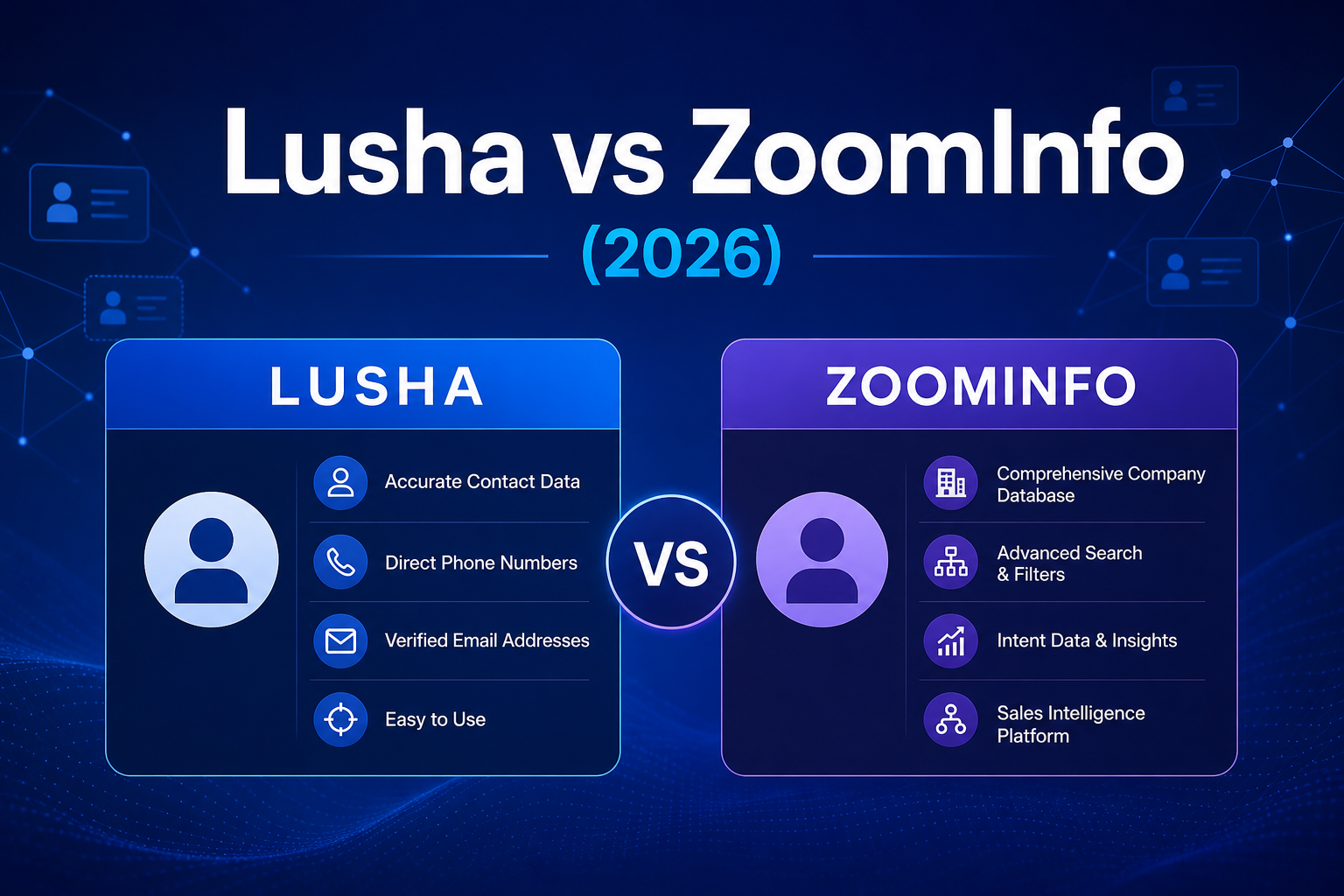
Lusha is usually the better fit for leaner teams that want faster access to direct dials and contact enrichment with a lower barrier to entry. ZoomInfo is usually the better fit for organizations that want a larger data operation, deeper account intelligence, broader workflow coverage, and more scale-oriented prospecting infrastructure.
Here is the practical buyer’s comparison.
Quick Comparison Summary
| Feature | Lusha | ZoomInfo |
|---|---|---|
| Best For | SMBs and outbound teams that want simpler prospecting and contact enrichment | Larger sales orgs that want deeper data coverage and more enterprise-grade workflow support |
| Core Strength | Ease of use, lighter buying friction, and fast list building | Database scale, account intelligence, and broader GTM tooling depth |
| Implementation Effort | Usually quicker and simpler | More involved, but more expandable |
| Operational Ceiling | Good for many SMB and mid-market outbound teams | Usually higher for scaled prospecting and enterprise sales workflows |
| Best Buying Trigger | You want efficient prospecting without paying for a huge platform | You want more complete market coverage and richer account-level intelligence |
Pricing Comparison
Exact pricing can shift by package and contract, but the buyer pattern in 2026 is still straightforward.
| Tool | Current Pricing Snapshot |
|---|---|
| Lusha | Lusha Lusha is usually easier to access for smaller teams, with plans that make contact enrichment and list building more approachable without forcing an enterprise-style commitment up front. |
| ZoomInfo | ZoomInfo ZoomInfo typically sits at a higher price point because buyers are paying for broader data coverage, stronger account intelligence, and a larger go-to-market data platform rather than a lighter prospecting tool. |
If budget sensitivity is central, Lusha is often the easier shortlist candidate. If scale and data breadth matter most, ZoomInfo usually justifies the higher spend better.
Lusha Overview
Lusha remains a popular choice in 2026 for teams that want prospecting software to feel lightweight, fast, and useful on day one. Many buyers are drawn to it because the product is comparatively easy to understand: find contacts, enrich leads, support outreach, and keep the workflow moving without a large implementation burden.
That simplicity matters for smaller sales teams, founder-led outbound, recruiters, and revenue orgs that need better data but do not want to buy an entire go-to-market intelligence machine. Lusha often gives enough value quickly to improve rep productivity without turning tool rollout into a project.
The tradeoff is scale depth. Buyers with more complex territory design, heavy account-based motion, or a need for broader intelligence layers often outgrow lighter prospecting tools.
ZoomInfo Overview
ZoomInfo still wins many deals in 2026 because it is built for teams that want more than contact lookups. Its value proposition is depth: larger database ambition, richer company intelligence, stronger segmentation potential, and a broader platform story around prospecting and go-to-market execution.
For larger organizations, that matters because the problem is rarely just finding one email address. It is building repeatable coverage across target accounts, enriching CRM records, supporting SDR workflow, improving routing, and giving leadership confidence in pipeline sourcing infrastructure.
The tradeoff is cost and complexity. ZoomInfo is less appealing when the team only needs a faster, cheaper way to source direct dials and basic enrichment.
Head-to-Head: Key Differences
Ease of Use and Speed to Value
Lusha usually has the advantage. Teams can start using it quickly, understand the workflow quickly, and get value without a long ramp. That matters for smaller organizations where every tool has to earn adoption fast.
ZoomInfo can absolutely deliver value, but it often makes the most sense when the organization is ready to operationalize a larger dataset and broader workflow surface.
Database Breadth and Intelligence Depth
ZoomInfo usually wins here. Buyers who care about account intelligence, broader market coverage, and more robust segmentation often prefer ZoomInfo because it is designed around a bigger data operation. If your outbound motion depends on depth and scale, ZoomInfo tends to look stronger.
Lusha still works well for many teams, but it is more often chosen for efficiency and accessibility than for being the most expansive intelligence layer in the stack.
SMB vs Enterprise Fit
Lusha is usually more comfortable for SMB and mid-market teams that want clear ROI without a heavy contract or complex rollout. ZoomInfo is usually stronger for larger organizations that have specialized sales ops needs, more reps, more segmentation complexity, and higher expectations for data coverage.
Value for Money
Lusha often wins on immediate price efficiency. If the team’s main need is better contact data for day-to-day outbound, it can be the more practical buy. ZoomInfo can still be the better value when better data depth meaningfully improves account selection, routing, enrichment quality, and pipeline generation at scale.
Workflow Ambition
ZoomInfo is usually the better choice when your leadership team wants prospecting infrastructure, not just contact lookup. Lusha is often the better choice when the job is simpler: help reps find the right people faster and keep the outbound engine moving.
Who Should Choose Lusha?
Choose Lusha if: you want a simpler, lower-friction prospecting tool that gets reps useful contact data quickly without enterprise-level spend or rollout complexity.
Who Should Choose ZoomInfo?
Choose ZoomInfo if: you want broader data coverage, richer account intelligence, and a platform that can support a more scaled sales development operation.
The Verdict
For lean outbound teams in 2026, Lusha is the better choice when ease of use, faster ROI, and lower buying friction matter most. For larger go-to-market organizations, ZoomInfo is the better fit when data depth, coverage, and operating scale matter more than tool simplicity. Lusha wins on efficiency and accessibility. ZoomInfo wins on scale and intelligence depth.
Ready to Choose?
Try Lusha → | Try ZoomInfo →
DrComps may earn a commission through affiliate links at no extra cost to you.
Try Lusha → | Try ZoomInfo →
DrComps may earn a commission through affiliate links at no extra cost to you.
Comments (0)