
Our Blog.
Ramp vs Expensify (2026): Which Expense Management Platform Is Better for Finance Teams?
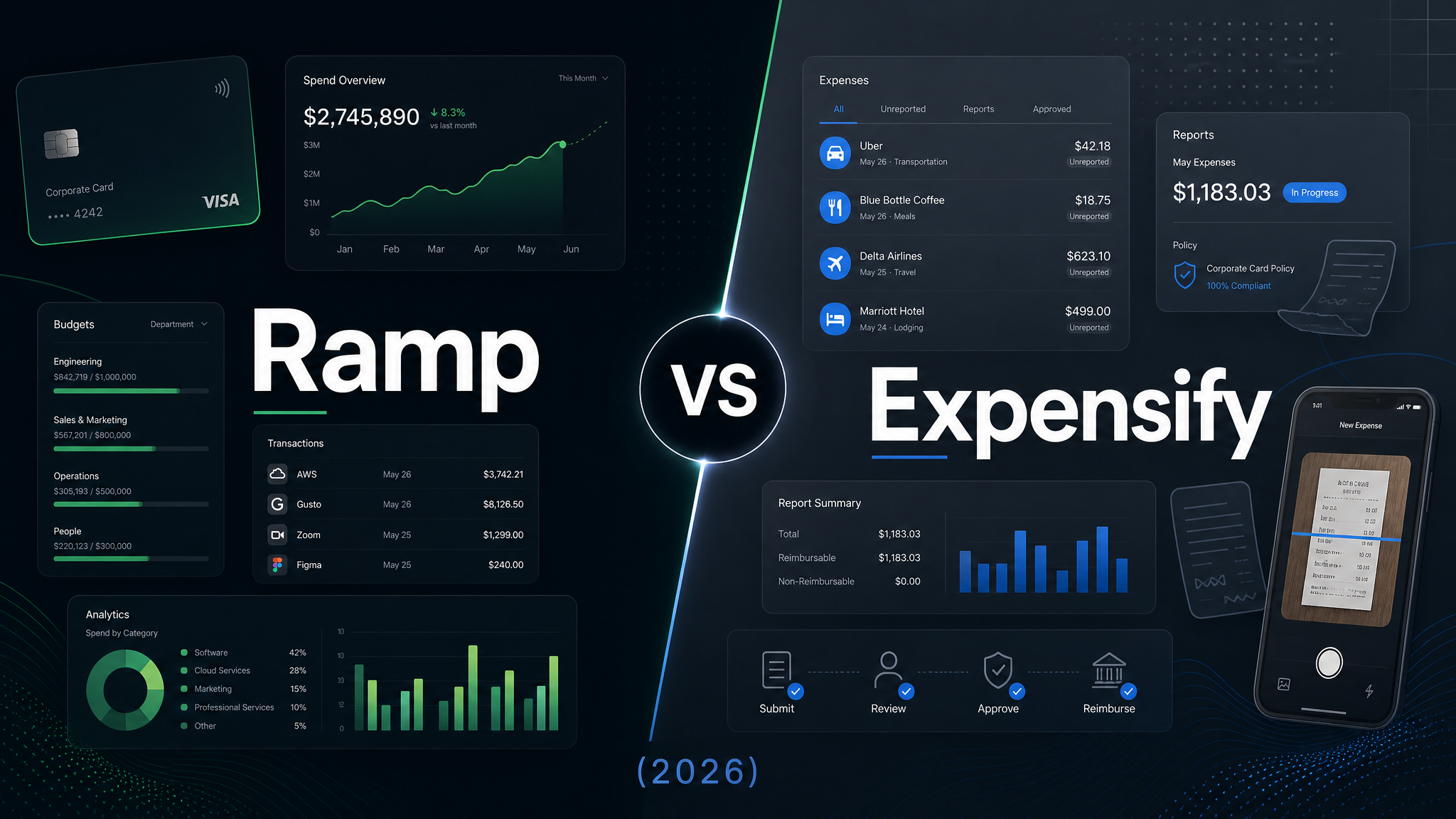
If you’re comparing Ramp vs Expensify in 2026, you’re probably not looking for a basic receipt app. You’re trying to decide which platform gives your finance team tighter spend control, less manual cleanup, and a cleaner path from card spend to month-end close.
Ramp is usually the better fit for finance teams that want an all-in-one spend management platform with strong corporate cards, accounts payable, procurement workflows, and automation built around cost control. Expensify is usually the better fit for teams that care most about employee expense reporting, reimbursements, and simple submission workflows without adopting a broader finance operations platform.
Here is the practical buyer’s comparison.
Quick Comparison Summary
| Feature | Ramp | Expensify |
|---|---|---|
| Best For | Finance teams that want broad spend management and automation | Teams that mainly need expense reports and reimbursements |
| Core Strength | Corporate cards, AP, procurement, and accounting automation in one system | Fast expense capture, approvals, and employee-friendly submission flow |
| Pricing Shape | Free plan, paid Plus plan, and custom Enterprise | Free basics plus paid business tiers centered on expense management workflows |
| Implementation Feel | More strategic rollout tied to finance policy and system automation | Faster to deploy for straightforward expense reporting needs |
| Best Buying Trigger | You want to replace fragmented finance tools with one modern stack | You want easier receipt capture and reimbursement workflows quickly |
Pricing Comparison
The biggest pricing difference is scope. Ramp is priced like a broader finance operations platform, while Expensify is easier to evaluate as an expense management tool first.
| Tool | Current Pricing Snapshot |
|---|---|
| Ramp | Ramp Ramp publicly shows a Free plan at $0/user/month, a Plus plan around $15/user/month plus a platform fee based on team size, and custom Enterprise pricing. Its value is strongest when you use cards, AP, expense controls, procurement, and accounting automation together. |
| Expensify | Expensify Expensify keeps a free entry point and paid business plans built around expense reporting, approvals, reimbursements, integrations, and admin controls. Public plan details vary by package and contract structure, but it is usually easier to adopt when the buying motion starts with expense management rather than a full spend stack. |
If your CFO wants one platform to enforce policy across cards, bills, and approvals, Ramp usually has the stronger business case. If the immediate pain is just expense reports and reimbursements, Expensify is usually simpler to justify.
Ramp Overview
Ramp has expanded well beyond corporate cards. In practice, buyers look at it as a finance operations platform that combines spend controls, employee cards, AP, procurement, vendor visibility, reporting, and accounting automation. It usually performs best when a company wants to reduce manual work inside finance while tightening policy control at the same time.
Its biggest advantage is platform breadth.
Expensify Overview
Expensify is still strongest when the core job is collecting receipts, routing approvals, reimbursing employees, and keeping expense reports from becoming a time sink. It is widely recognized, easy for employees to understand, and often a lighter operational lift for teams that do not want to redesign the broader finance stack yet.
Its biggest advantage is simplicity for expense reporting.
Head-to-Head: Key Differences
Scope of Platform
Ramp is much broader. It aims to manage spend across cards, bills, reimbursements, and procurement workflows. Expensify is narrower and stronger when the main need is expense reporting and reimbursement.
Finance Automation
Ramp usually wins if the buyer cares about automation across approvals, coding, policy enforcement, and accounting workflows. Expensify can streamline expense tasks well, but it is not usually the first choice when the finance team wants to modernize the entire spend process.
Employee Experience
Expensify often feels more familiar for employees who just need to submit receipts, create reports, and get reimbursed. Ramp is still user-friendly, but its value is more finance-team-centered than expense-report-centered.
Policy Control
Ramp has the edge when spend controls matter. Card limits, approval logic, vendor visibility, and automation around compliance are a major part of the product story.
Implementation Complexity
Expensify is usually faster to deploy for a focused expense use case. Ramp asks for a broader rollout conversation because it can touch cards, bill pay, accounting sync, and procurement processes.
Best Buyer Profile
If the buyer is a finance leader trying to consolidate tools and increase control, Ramp is often the better fit. If the buyer is an operations or finance admin who mainly needs a better employee expense workflow, Expensify is often enough.
Who Should Choose Ramp?
Choose Ramp if: you want stronger spend controls, modern finance automation, corporate cards, AP workflows, and a platform that can replace multiple point solutions.
Who Should Choose Expensify?
Choose Expensify if: you want fast expense reporting, easy reimbursements, a familiar user experience, and a narrower rollout that does not require reworking your full finance stack.
The Verdict
For most buyers comparing these two in 2026, Ramp is the better choice when the goal is broader spend management, tighter finance controls, and more automation across the business. Expensify is the better choice when the main problem is expense reporting and reimbursements, and you want a simpler deployment. Ramp wins on finance platform depth. Expensify wins on focused expense simplicity.
Ready to Choose?
View Ramp pricing → | View Expensify pricing →
DrComps may earn a commission through affiliate links at no extra cost to you.
View Ramp pricing → | View Expensify pricing →
DrComps may earn a commission through affiliate links at no extra cost to you.
Comments (0)