Our Blog.
Aircall vs RingCentral (2026): Which Business Phone System Is Better for Sales and Support?
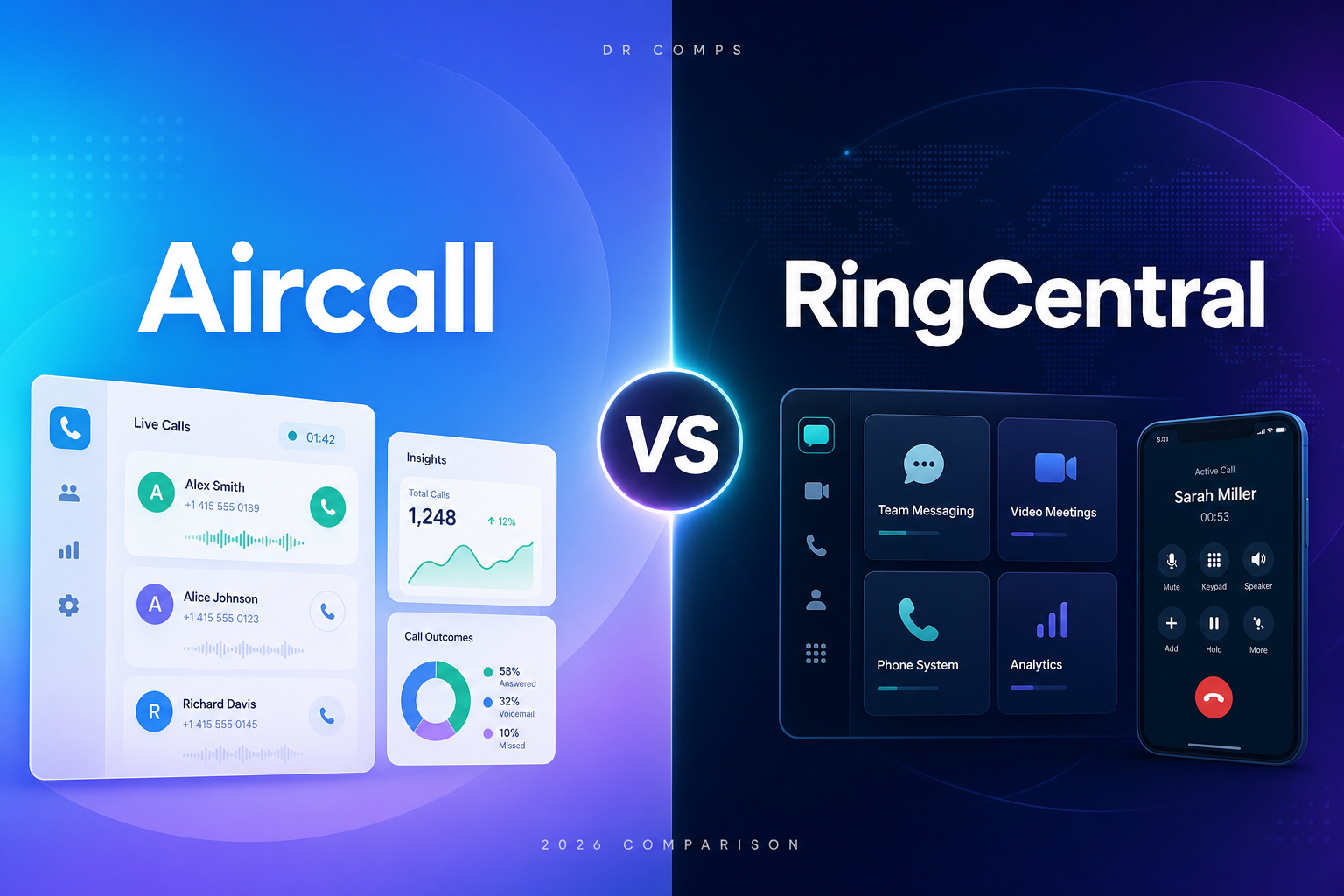
If you’re comparing Aircall vs RingCentral in 2026, you’re usually deciding between two very different approaches to business communications. One is built to feel like a modern cloud calling layer for sales and support teams. The other is built as a broader unified communications platform that can stretch further across the company.
Aircall is usually the better fit for revenue and support teams that want a cleaner cloud phone system with fast setup, CRM integrations, and call-center-friendly workflows. RingCentral is usually the better fit for businesses that want a broader communications suite spanning calling, messaging, meetings, and deeper enterprise telephony coverage.
Here is the practical buyer’s comparison.
Quick Comparison Summary
| Feature | Aircall | RingCentral |
|---|---|---|
| Best For | Sales and support teams that want fast cloud calling deployment | Businesses that want a broader all-in-one communications platform |
| Core Strength | Modern call workflows, CRM integrations, and team productivity features | Broad unified communications coverage with voice, messaging, video, and admin depth |
| Pricing Shape | Per-license plans with a sales/support orientation and add-on AI layers | Tiered per-user pricing across communications bundles and advanced tiers |
| Implementation Feel | Cleaner and more focused when the core job is handling calls well | Broader but more complex, especially for larger organizations |
| Best Buying Trigger | You want a modern phone system tightly aligned to go-to-market teams | You want one vendor for business communications across more departments |
Pricing Comparison
Pricing helps frame the tradeoff. Aircall is easier to read as a modern calling product for customer-facing teams, while RingCentral looks more like a broader UCaaS platform with multiple tiers and add-ons.
| Tool | Current Pricing Snapshot |
|---|---|
| Aircall | Aircall Aircall pricing starts around $30 per license/month on annual billing for Essentials, with Professional around $50 per license/month and custom pricing for larger deployments. The platform also layers in optional AI and analytics add-ons. |
| RingCentral | RingCentral RingCentral RingEX pricing commonly starts around $20 per user/month for Core, with Advanced around $25 and Ultra around $35 on annual billing, plus separate add-ons for functions like AI receptionist and advanced engagement layers. |
If your team mostly needs high-quality sales and support calling, Aircall’s pricing structure can feel more direct. If you want broader communications coverage beyond the phone stack, RingCentral often gives more room to grow.
Aircall Overview
Aircall is designed for teams that live on the phone with prospects or customers and want those calls closely tied to CRM and help desk workflows. It tends to feel modern, focused, and quicker to operationalize for sales and support leaders who care about routing, tagging, monitoring, coaching, and integrations more than general-purpose enterprise telephony breadth.
Its biggest advantage is focused calling productivity for customer-facing teams.
RingCentral Overview
RingCentral is broader. It is usually bought as part of a bigger communications strategy that includes voice, messaging, meetings, administration, and more enterprise-ready controls. That can make it a better long-term platform if the phone system needs to serve many departments, locations, or policy requirements rather than just frontline sales and support teams.
Its biggest advantage is all-in-one communications breadth.
Head-to-Head: Key Differences
Sales and Support Workflow Fit
Aircall usually wins here. Its product shape is more obviously tuned for call-heavy revenue and support teams.
Unified Communications Breadth
RingCentral usually wins here. It stretches further across business phone, messaging, meetings, and broader enterprise telephony needs.
Ease of Setup
Aircall often feels lighter and faster to launch for teams that mainly need cloud calling with good integrations.
Enterprise Administration
RingCentral often has the edge for larger organizations that need deeper admin controls, broader deployment options, and a more complete communications stack.
Go-to-Market Team Focus
Aircall is usually the better fit when the buying team is led by sales operations, support operations, or a revenue leader who wants adoption fast.
Best Buyer Profile
If the buyer mainly wants a modern cloud phone system for customer-facing teams, Aircall is often the better match. If the buyer wants to standardize communications across the wider business, RingCentral is usually the smarter platform choice.
Who Should Choose Aircall?
Choose Aircall if: you want fast setup, strong CRM and help desk integrations, and a business phone system centered on sales and support performance.
Who Should Choose RingCentral?
Choose RingCentral if: you want a broader unified communications platform with more enterprise telephony depth and cross-department coverage.
The Verdict
For most buyers comparing these two in 2026, Aircall is the better choice when the goal is improving calling performance for sales and support teams without adding unnecessary platform weight. RingCentral is the better choice when the goal is consolidating business communications more broadly across the organization. Aircall wins on focus and speed. RingCentral wins on platform breadth.
Ready to Choose?
View Aircall pricing → | View RingCentral pricing →
DrComps may earn a commission through affiliate links at no extra cost to you.
View Aircall pricing → | View RingCentral pricing →
DrComps may earn a commission through affiliate links at no extra cost to you.
Comments (0)