Our Blog.
n8n vs Zapier (2026): Which Automation Platform Is Better for Modern Teams?
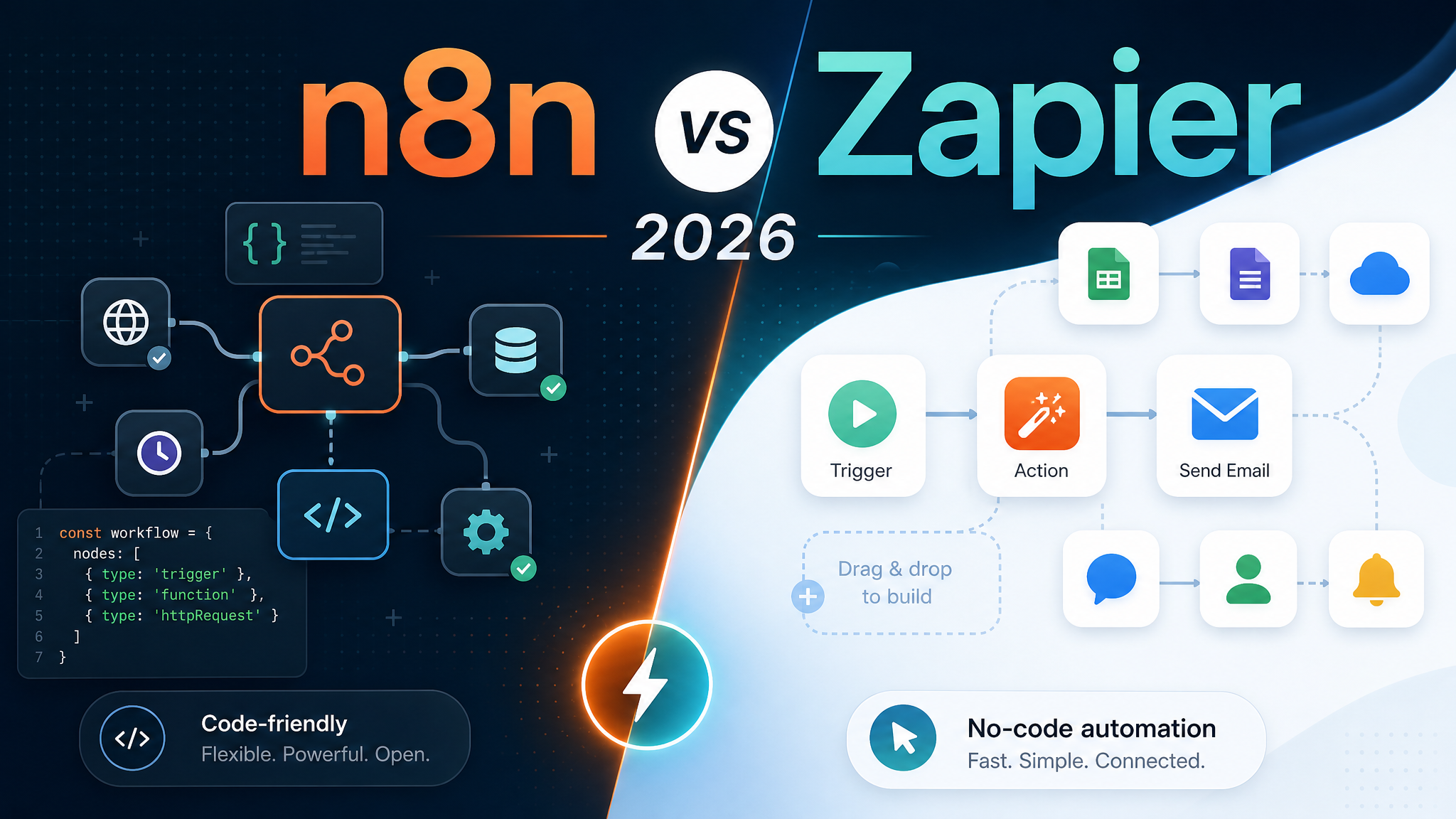
If you’re comparing n8n vs Zapier in 2026, you’re usually deciding whether your team wants maximum flexibility and workflow control or the easiest way to automate business processes across a massive app ecosystem.
n8n is usually the better fit for technical teams, AI-heavy workflows, and buyers who care about self-hosting, execution economics, and deeper workflow logic. Zapier is usually the better fit for business users who want fast no-code automation, huge integration coverage, and the shortest path from idea to working workflow.
Here is the practical buyer’s comparison.
Quick Comparison Summary
| Feature | n8n | Zapier |
|---|---|---|
| Best For | Technical teams that want flexible automation, AI workflows, and hosting control | Business teams that want fast no-code automation across thousands of apps |
| Core Strength | Workflow depth, code-friendly logic, and economics based on full executions rather than every step | Ease of use, integration breadth, templates, and quick automation rollout |
| Pricing Shape | Lower entry pricing for hosted plans and strong value if you want self-hosting or unlimited users | Can start quickly, but costs often rise as workflows, tasks, and premium apps increase |
| Implementation Feel | More powerful and more technical, with more room for custom logic | More approachable for non-technical teams that want to move fast |
| Best Buying Trigger | You want deeper control, AI orchestration, or better cost efficiency at scale | You want the fastest possible path to automating common SaaS workflows |
Pricing Comparison
The pricing decision matters, but the bigger question is whether your automation strategy is primarily business-user convenience or workflow control at scale.
| Tool | Current Pricing Snapshot |
|---|---|
| n8n | n8n n8n publicly lists a Starter plan at €20/month billed annually for 2.5K workflow executions, a Pro plan at €50/month billed annually for 10K executions, a Business plan at €667/month billed annually for 40K executions, plus enterprise pricing. The important point is that n8n emphasizes paying per workflow execution, not per step. |
| Zapier | Zapier Zapier offers multiple tiers, a free starting point, and a broad menu of automation products, but total cost often rises as task volume, multi-step workflows, premium apps, and team governance needs expand. For simple business automations it is easy to start. For heavier production usage, buyers should model growth carefully. |
In practice, n8n is easier to justify when you expect more complex workflows, AI agents, or scale-sensitive automation economics. Zapier is easier to justify when speed, usability, and app coverage matter more than low-level control.
n8n Overview
n8n has become a serious contender because it gives teams much more control over how automation is built and run. It supports richer branching, custom logic, technical workflows, self-hosting options, and increasingly relevant AI workflow patterns.
That makes n8n attractive for startups, technical ops teams, internal tooling teams, and organizations that do not want their automation layer boxed into a purely point-and-click model. It also matters that n8n lets teams think about workflow executions differently, which can become economically attractive as usage grows.
The tradeoff is accessibility. n8n is more approachable than raw code, but it still rewards technical comfort more than Zapier does.
Zapier Overview
Zapier remains the default answer for a lot of buyers because it is easy to start, easy to explain, and connected to an enormous number of SaaS apps. If the team wants to automate lead routing, form notifications, CRM updates, spreadsheet syncs, or everyday business handoffs, Zapier usually gets there quickly.
That simplicity is commercially powerful. A non-technical ops or marketing team can stand up useful workflows fast, rely on templates, and avoid waiting on engineering.
The tradeoff is that deeper logic and larger-scale usage can become more limiting or more expensive than buyers expect. Zapier is excellent at convenience. It is not always the best choice for buyers optimizing for control or long-run economics.
Head-to-Head: Key Differences
Ease of Use
Zapier usually wins here. It is easier for non-technical teams to understand and launch quickly.
Workflow Depth and Flexibility
n8n usually wins here. It offers more room for branching, custom logic, AI workflow orchestration, and technical customization.
Integration Breadth
Zapier usually wins here. Its ecosystem coverage and template library remain major reasons buyers choose it first.
Control and Hosting Options
n8n usually wins here. Self-hosting and stronger architectural control matter for teams with security, compliance, or infra preferences.
Best Buyer Profile
If the buyer wants the easiest business automation platform with broad app coverage, Zapier is usually the safer choice. If the buyer wants more control, more technical power, and stronger scale economics, n8n is usually the better choice.
Who Should Choose n8n?
Choose n8n if: you have technical comfort on the team and want deeper workflow logic, AI-oriented automation, self-hosting options, or a pricing model that can make more sense for heavier usage.
Who Should Choose Zapier?
Choose Zapier if: you want the shortest route to useful no-code automation across a huge app ecosystem and you care more about convenience than infrastructure-level control.
The Verdict
For most non-technical business teams in 2026, Zapier is the better choice because it is easier to adopt and easier to connect across a massive SaaS stack. n8n is the better choice for technical teams, AI workflow builders, and companies that want deeper control or better long-run automation economics. Zapier wins on convenience. n8n wins on power and flexibility.
Ready to Choose?
Try n8n → | Try Zapier →
DrComps may earn a commission through affiliate links at no extra cost to you.
Try n8n → | Try Zapier →
DrComps may earn a commission through affiliate links at no extra cost to you.
Comments (0)